

How To Set Umask For A Particular User In Linux

Introduction to Linux Umask
UMASK is an abbreviation for user mask and is sometimes called a User file cosmos mask. In Linux, there are many instances when one would demand to create a file or a directory as per the utilise instance requirement. While doing this, one needs to brand sure that the permission of the newly created file or directory should comply with the use example scenarios. Now, suppose a Linux system is used for developing applications suited for but one kind of scenario tackling. In that instance, information technology is erstwhile to modify the base of operations permission or the default permission of the newly created files or folders. UMASK is the command that comes in handy while fixing the default permission to something that most applications being developed in that Linux box would typically have.
Syntax
Earlier we even leap into understanding what scenarios umask would help or what is the working principle of umask, it is benign to understand the syntax backside the umask then that while going through the working principle, we can keep the syntax in listen.
Syntax #1
umask <1st number><2nd number><iiird number>
Here, umask is the keyword or command which will instantiate the activity of umasking. <onest number>is the number that would be given for the owner <twond number>is the number that would be given for group <3rd number>is the number that would be given for others. Now, these numbers are adjudged according to the octal notation nosotros have for each of the targeted audiences. Octal numbers volition vary from 0 to seven, each number signifying detail permission. These numbers are not the same equally the ones you would be expecting to meet for file permission. The reason is that there is a adding that takes place to get permission. Then, the numbers stated below is to exist used to go the desired permission, and not necessarily the numbers listed below will signify the permissions listing. The different scenarios (for directory) are:
0: read-write and execute
1: read & write
2: read & execute
three: read-only
iv: write & execute
5: write merely
half dozen: execute only
7: no permission
If yous recall from a previous understanding of file permission, y'all would see that the numbers are just the contrary of the actual file permission numbers. The reason is the calculation nosotros will talk about. Using the numbers in the umask, you would run into that the permission to the file or directory is the ane you would be expecting every bit text and not the numbers listed above. And so, for example, after calculation, if umask is 1st number is 0, you would get 7 or 6 as the 1st number post calculation, and that is exactly the number for reading, write and execute for a file or directory, respectively.
Syntax #2
umask u=rwx, m=, o=
Hither umask is the same keyword, u refers to users, yard refers to groups,o refers to others. And the letters r refers to read,w refers to write,x refers to execute. Here besides, there is a calculation that will follow to go to the actual file permission.
How Does Umask Work in Linux?
In lodge to understand how umask works in Linux, it is more important to note a few of import parameters that become the base for obtaining the file permissions. By default, base permission for a file is 666, and the directory is 777. Number 7 won't exist, and number 6 will have activeness as No permission in case of files. This is because it is a rule of thumb that files with execute permissions are non allowed to be created by Linux, and one would demand to do that later on the file is created and as a separate stride!
The next thing is how and where exercise nosotros modify the value of umask. This needs to exist changed in the ~/.bashrc file. ~/.bashrc lets you set parameters or attributes or configurations for final sessions. In case you need to change the umask for only current sessions, you would need to put it equally a command-line input.
umask 027
                umask
Output:
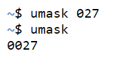
Once you have set up the umask values, these will endeavour to exist used as a Non operator to calculate the file permissions. As already mentioned, the default base permission for files is 666. The directory is 777; let the states look at ii unlike calculations (for files and directory) to sympathize how nosotros arrive at permission numbers from the umask code.
Scenario: Get inside a directory, and only the user can read and write; groups can but enter the directory and read &others have no permission (umask 027)
Get File permission
The intention is to decrease the umask number from the base of operations permission to go the bodily file permission. For instance, if the umask is 027 [0 (read & write for user), 2 (read-only for the group), vii (no permission for others)] then the adding is every bit follows:
Base permission: 666
umask: 027
File permission: 666 – 027 = 640* (rw-r—–)
*Please note that vi – vii is -ane, only in Linux, information technology is adjusted to be 0.
Become Directory Permission
The intention is to subtract the umask number from the base permission to get the actual file permission. For instance, if the umask is 022 [0 (read, write& execute for user), ii (read & execute for group and others)] then the calculation is as follows:
Base permission: 777
umask: 027
File permission: 777 – 022 = 750 (rwxr-10—)
In the above scenario, users tin can read, write and execute in a directory and can read and write in a file inside it.
Groups can read and execute into a directory but can only read a file inside it.
Others can do zero, i.e., no permission.
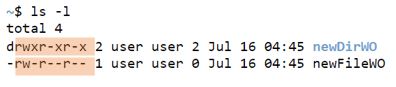
Without umask
Lawmaking:
mkdir new DirWO
                touch new FileWO
                ls -50
Output:
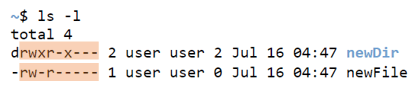
With umask
Code:
umask 027
                mkdir newDir
                touch new File
                ls -l
Output:
A useful tip: Effort to first understand the base of operations scenario and then watch out for permission in a numerical form. Then subtract information technology from the base of operations permission to become the umask number.
Conclusion
In this commodity, we accept learned about how nosotros use scenario-based numbering to sympathize what the default umask number should be, so in accordance with that, we set up the umask either in bashrc or only for that terminal only as per requirement.
Recommended Articles
This is a guide to Linux Umask. Here we discuss how Umask works in Linux and the mask and without mask codes and outputs. You may also have a await at the following articles to acquire more –
- Linux Network Command
- Linux Alias Control
- Linux rm Command
- Linux tr Command
Source: https://www.educba.com/linux-umask/
0 Response to "How To Set Umask For A Particular User In Linux"
Post a Comment